Tuesday, 12 March 2013

Empolyment Opportunities

Types Of Contract:

- A contract is a legally binding document that states you work for the company (or place) and agree to their terms and conditions, you have a contract so if they overwork or underpay you. you can have them taken to court for dissobeying there contract to you.

The types of Contact

Temporary- A Temporary Contract basically means your only there for a short-time your only there for a short while.

Perminant- A Perminant contract means your there full time, everyday (scheduled) You can leave if you want, it doesnt mean your their forever.

Full Time- Full-time employment is employment in which a person works a minimum number of hours. Full-time employment often comes with benefits that are not typically offered to part-time, temporary, or flexible workers, such as annual leave, sickleave, and health insurance.

Full-time workweeks:

  • Australia: around 35–40 hours

  • Chile: 45 hours

  • Denmark: 37 hours

  • France: 35 hours (government-mandated)

  • Germany: 35–40 hours

  • Iceland: 40 hours

  • Brazil: 40-44 hours

  • United Kingdom: 35 hours

  • United States: around 40 hours

  • Israel: 43 hours
Part Time- A part-time job is employment that carries fewer hours per week than a full-time job, Workers are considered to be part-time if they work fewer than 30 or 35 hours per week.

Fixed Term- A contract which is valid only for a pre-arranged time, The bosses arranges what time the employer comes and leaves work, they also chose what day and how many days they want him or her to work.

Freelance- A freelancer, freelance worker, or freelance is somebody who is self-employed & Works for different companies at different times rather than being permanently employed by one company.

Casual- is a contract where the employee gets paid based on how many hours they work, the job isnt very relyable as the employer could be working many hours one week and none the next.

For a task i have to order what i think is the most important whilst trying to find work in the industry. i had a list of things you had to be to get a job in the media industry so i had to list them from 1-10.

- meet deadline (1)
- able to take direction (6)
- ask for help/ advice (10)
- good functional skills (5)
- good communication (4)
- punctionality (2)
- reliability (7)
- work as a team (9)
- work under pressure (3)


Different Jobs in:
creative, technical, editorial, managerial, administrative, Financial.

Jobs that are creative in the media Sector: Senior Digital Designer, Web Developer graphic Novelist, Interior Designer, Creative Solutions Manager and eCommerce Web Developer
Techinical Jobs: Camera operative, Producer, lighting, Spotlights, Film Producer Intern, sound audio, Prop maker and Set design.


Editorial jobs:Writer, editor, Script Writer,Senior Copywriter, Assistant Producer, Copywriter, Design Manager and final Cut pro Editor.


Administrative jobs:Marketing Communications Executive, Course Leader Media Culture and Communication, Digital Marketing Consultant (SEO, Social Media, Creative Content), Marketing & New Business Executive


managerial jobs: Creative Comms - HR Business Partner,Account Manager, Digital Project Manager, Receptionist/Assistant to Studio Manager and Creative Director / Manager.


Financial Jobs: Finance Director, Project Accountant, Finance Manager, Finance / Procurement Officer, Finance Assistant, Payroll Assistant and Assistant Management Accountant.


Tuesday, 12 February 2013

Regulatary Bodies

regulator bodies- Issues

What is monopoly?

A monopoly is simply a market with only one seller and no close substitutes for that seller's product. Technically, the term "monopoly" is supposed to refer to the market itself, but it's become common for the single seller in the market to also be referred to as a monopoly (rather than as having a monopoly on a market). It's also fairly common for the single seller in a market to be referred to as a monopolist.

Why is it important to ensure that no one single media producer in the UK has a monopoly?

The new communication technology is exciting but it itself going to democratize anything. But the problem with our present democracy is not that all of us don’t have an adequate communication, our parliamentary representatives already know the polls that the majority oppose privation, health cuts and recent huge rises for the rich. The problem with the monopolies is that there a socially and politically tied to the establishments and we have no control of them.

Why is consumer choice important?

Cosumers choice is important because There are two different consumers involved, in the first case consumption can be a primary individual and in the second case a producer might make something that he would not consume himself, therefore, different motivations and abilities are involved.


 What is censorship?
Censorship is the editing of material from a written or visual presentation, things are cencored when they are inapproriate like a sexual or nude scene, acts of violence or bad language (swearing) "Hate speech" (religious, ethnic, or racial insults) things have to be censored on TV, radio, music or sometimes very rarely on the internet.


 What are the arguments for and against censorship?

Pros:
1) Protection of minors from pornographic material
2) Protection of information/intelligence of National Security, Including information regarding the Military (weapons tech, enemy knowledge, etc.)
3) Promotes good morals
4) Prevents grossly violent messages/events from being delivered
5) Prevents spread of harmful information

 Cons:
1) Freedom of Speech is violated
-also, the freedom of the press
2) Prevents the spread of ideas and knowledge
-leads to ignorance and bias beliefs
3) Usually associated with dictatorships, not progressive democracies
4) Encourages curiosity about censored material
5) Resists questioning of conventional ideas
 

Why should under 18's be subject to particular considerations by regulators?

The majority of legal considerations involve a lot reporting restrictions. Reporting legal proceeds is a very complex area of law and legal advice and must be sought at an early stage and certainly before anything else happens. It is a contempt of court i.e. a criminal offence, to identify a child in contravention of an order of the court or in contravention of legal restrictions

Regulator Bodies

Office for communication- is communication Regular bodythat regulates with TV and Radio Sectors, offcom has a fixed line with telecoms and also Postal Services also with airwaves and Wireless device operates. On 21st february they reorganised and completed a internal review, this was designed to reduce a expenditure to challenge the whole of the public sector.


Adversting Standards Authority-is one of the uks independant bodies that advertise all over the media in the uk there a certain advertising codes that the asa has to follow and they were written by the committees of advertsing practise.  There work included acting on loads of complaints and checing the media for action against any misleading or harm to any other people.


Tuesday, 29 January 2013

Leveson Inquiry

The Leveson Inquiry is a public inquiry into the culture, practices and ethics of the British press following the phone hacking scandal, chaired by Lord Justice Leveson, who was appointed in July 2011. The Inquiry published the Leveson Report in November 2012, which was reviewed the general  ethics in the British media, and made recommendations for a new, independent, body to replace the existing Press Complaints Commission which made new laws.


Madeline McCann's Parents
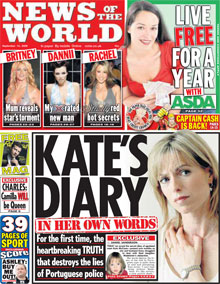
The 'News of the World' paper stole and published her diary in there newspaper. Madeline's mum Kate, said seeing her private diary published in the News of the World made her feel "totally violated". Madeline's father Gerry McCann told the Leveson Inquiry many of the stories were untruthful, sinister or, he believed, made up. They told the News of the world team "We feel that a system has to be put in place to protect ordinary people from the damage that the media can cause by behaviour which falls far below what I would call acceptable."

The picture below is a picture of the original newsprint featuring kate's story.
 
Heather Mills

in 2001, heather mills returned home from india to lots of messages from her boyfriend Sir Paul McCartney. Piers Morgan mentioned he had listened to the messages but refused to say when or where because he wanted to protect a "source". Heather said she never authorised Piers or anybody to listen to her voicemails she said "I couldn't quite believe that he would even try to insinuate, a man that has written nothing but awful things about me for years, would relish in telling the court if I had played a voicemail message to him,"

 
Sienna Miller

When personal information appeared in newspapers sienna miller accused close family & friends for betraying her trust. Sienna said she had gathered people in a room to question them after a story emerged based on something only four people knew about. "I accused someone in that room of selling a story." she also told the leveson inquiry "Nobody could understand how this information was coming out," she said, "it was impossible to lead any kind of normal life at that time and that was very difficult for a young girl."


Tuesday, 15 January 2013

Ethical Issues


Ethical Issues.
 
For this assignment we listened to a radio show that contained comedians russel brand & jonothan ross, as they couldn't get guest star presenter Andrew Sach's on the show they decided to phone him when they phoned him they left many rude messages on his answer phone.

The BBC did many things wrong during the Russell Brand & Jonathan Ross radio broadcast. For example they bbc didn’t do any of the following:

They didn’t edit the show before airing it.

They told him personal things like (Russell Sleeping with Andrew’s niece & how they did it)

They didn’t get Andrews consent in airing it. (When they said they did)

They didn’t tone down like Andrew asked.

They repeatedly kept phoning Andrew even though he clearly wasent home.


Ofcom fined the BBC £150,000 over the calls made to Sachs.


What are ethical issues?

Ethical issues involve right and wrong or what is considered good, and what is considered evil in a society. Ethical issues are also problems or dilemmas involving moral compromise. They can arise anywhere.

Tuesday, 8 January 2013

Copyright Laws

Copyright and Intellectual Property Law

Pipa and Sopa is a copyright law which stops piracy, such as downloading movies, games, videos, music. It also stops you uploading copyrighted material onto youtube or dailymotion or on any other websites. An example is Apple sued the people who made a Samsung Galaxy Tablet because they accused them on copying there design, the galaxy tablet is basically the same design as the ipad but is sold cheaper. The iPad is £344 & Tablet is £228

Libel Law

Libel Law is a law that presents reporters from writing false stories about proof of it being real. If a newpaper prints lies about celebrities for there own personal benifits it can damage there reputation. for example  Frankie Boyle won £54,650 because the daily mirror printed he was a racist.

Privacy Law
The definition of privacy in england is "the right to be left alone." Other privacy laws states that "Personal data shall be obtained" Examples of broken privacy in media.

- Phone Hacking Scandle.
- Kate Middleton's Topless Photo's.
- Tulisa's Sex Tape.
- Prince Harry in Vegas.

Broadcasting Act 1990

The british broadcasting act was created to change the structure of TV or Radio, With the act in place it was allowed for another television channel to be added which was turned out for be channel 5. this also ment that other people can add new channels & run by one franchise. The act also brough more content to be broadcasted to be created from independent production companies. The act also allowed new radios to be put in place on frequencies. because the TV companys and radios where only allowed a certain percentages of TV and radio broadcasting.

Obscenity Law

The Obscenity Law is a act of parliament in the United kingdom, the obscenity law was prior to the passage of the law acting on publishing materials which was governed by the common law case of R v Hicklin. The Obscenity law created a new offence for publishing materials that repealed the common law of obscene libel which was previously used, this allowed any justice of peace to toss out warrants allowing any material to be seized from any person in the United Kingdom.

Prior to the passage of the act the law on publishing obscene materials was governed by the common law case of R v Hicklin. The Act created a new offence for publishing materials, repealing the common law of obscene libel was previously used, allows any justice of peace toissue warrants allowing any material to be seized from people.

The different between law and ethical is that the law is a regulation which is established and usually written down by the government, ethics are morals from cultures and they follow the laws that are made by the government. An important thing about ethics is that ethics has nothing to do with punishment but in law if you break it then you get punished when you break it.

Tuesday, 9 October 2012

Media Industrys
Film Industry:-

The film industry is a global industry and is one of the largest of the creative media sectors


There are 6 stages of development in film they are;
  • Development
  • Production
  • Facilities
  • Distribution
  • Exhibition
  • Export
  •  
There are about 400 film companies, In 2004 the UK industry Contributed £4.3 billion to the UK economy.

In 2007 the UK production activity was £747 million, making this the fourth highest year to date!

In 2007 516 films were release in the UK this was a increase over the decade.

Examples of films made in the UK - Harry Potter, James Bond, Chronicles of Narnia.  Some of the most commercially successful films of all time have been produced in the United Kingdom, including the two highest-grossing film franchises (Harry Potter and James Bond)

Thousands are employed only in the UK. The film industry has a work load of around 27,800 people.

Here are the names of some the big names in the film industries.


    Warners Bros


    Metro-Goldwyn-Mayer


    Dreamworks


    Working Title


    New Line Cinema


    Universal


Tuesday, 2 October 2012

Understanding Creative Media Industries.

  • Photo Imaging
  • Games
  • Radio
  • TV
  • Advertisting
  • Publishing
  • Interactive Media
  • Animation
  • Film


Film.
The Motion Picture Industry grossed $65,000,000,000 in 2007. but in 2012 the movie industry makes more than one billion each year, The industries are made up of a small number of big companies which are highly skilled. The United Kingdom's film industry is broken down into 4 sectors Production, Facilities, Distribution and Exhibition.


Publishing

Publishing is made up of a large group of industries including: Books, Directories and Mailing Lists, Journals, Magazines and Business Media, Newspapers, News Agencies and other Information Services.  

The publishing industry employs 195,000 people. 51,000 people are employed in the newspaper sector. 50,500 working in journals and magazines, 33,000 in the book industry & 12, 000 in other activities. 

Alot of the complains are based in London and South East of England but sources have proven there not very popular. 54% Male & 46% Female's work in this industry although it drops to 35& in news agencies.


Animation
Animation is a worldwide corporation but around 4,700 people throughout the UK work in the animation business. Draw/stop motion animation are employing around 1,000 people, Producing 910 people, Computer Generated Animation 900 people & production 430 People. A further 1,100 more people are employed in the key animation roles. 

34% of the animation workers are women.  39% of the workers in animation have worked there since 1990. 22% since 2000. 3% the representation of the ethnic minorities is among the lowest of all sectors of the audio visual industry.


Games
Games businesses employ total of 7,000 people in the UK. The most common occupations are Art & Design accounting for 1,700 (24%) managements accounting for 1,500 (22%)  and production accounting for 1,350 (19%) other smaller groups are strategic management (6%), Animators (6%), content development (3%) and audio/sound/music (2%) all other occupations are just 4% of the workforce. 

The age profile of the games industry show the aim towards younger employees with 61% of the workforce ages 35 or under and 23% of those employees to have children. Overall the computer games industry has around 486 businesses with majority being classes as games developers around 35 companies can also be classes as games support. 


Advertising 
The Advertising industry generates £6.2 billion for the UK economy. Advertising is a large firm. The advertising industry have 13,000 companies and almost 250, 000 people working in advertising. 

59% of people working in the advertising business have atleast level 4 qualifications and a third have a level 2 or 3 qualification. The UK has third biggest advertising firm in the world after USA & Japan. 


Interactive Media
The interactive media sector has around 34,300 employees representing approximately 7% of the total creative industries workforce

The work force is highly qualified 36% hold a postgraduate qualification and a further 43% hold an undergraduate degree. 


Photo Imaging

The photo imaging industry has a highly skilled and well qualified workforce 46% of the work force have a degree. 42% of those holding a undergraduate degree or diploma having a qualification in a media related subjects

The photo imaging industry has a low proportion of people from minority ethnic groups. 


TV
Television is still one of the most popular forms of entertainment and information with the average British viewers still watching twenty hours or more per-week, But the internet becoming so popular it is competing strongly for audiences. 

Just under two thirds of the TV industry's (62%) is based in lond. The north west is the second largest centre with 8% of the workforce. They are both broadcasting and production companies in Glasgow, Cardiff, Bristol, Birmingham, Leeds and Liverpool. 

Women are well represented in the TV industry, with 41% female workers out of the 49% although the overall representation of women in the tv workforce has declined year on year from 49% in 2004. 


Radio
They are many radio stations dotted around the UK although a majority of workforce are based in London. the radio workforce is older than that of the Creative Media Industries as a whole. About half the workforce is female


Also the radio industry employs a relatively low proportion of people from minority ethnic groups. 


These are a rage of sources of income that are made by the media industries

Downloads - money is made to downloads on tv, films through online sites such as netflicks, lovefilm, itune, amazon. audiences pay to download and watch them!

Advertisers - Advertising is one of the most popular sources of income for creative media industries as they can charge companies to advertise their product inbetween their media service. 

Sponsorship - Sponsership means you get exclusive promotion, sponsers get mentioned at the begining, middle & end of the program (for example, Hollyoaks they are sponsered by nikon)

Product placement - Product placement is having something in the background of popular tv shows, because people who watch  the tv show regulary will notice these items and if they like the thing they will go out and buy it.

BBC Licence fee - The annual cost of a colour TV licence is £145.50 (as from 1 April 2010). A black and white TV licence is £49.

Cinema box office - Cinema Box Offices Sell tickets to audiences for a particular movie thats showcasing, people buy the tickets.

Franchises, formats - Simon cowell sells his ideas and sells them to a company oversea's but he gets all the money that if makes, for example, simon created the xfactor in the uk but he created a USA version, another example Big Brother UK was sold and they created a Indian version of Big Brother.

CD and DVD sales - money is made because dvd sales lower there prices therefor people buying it because it's a bargain. they do this alot to get rid of alot of the older movies,

Television subscriptions -  Tv Subscription is when someone subscribes to a certain channel they get a wider viriaties of channels such as Sky.
 
Merchandise - Merchandise make there money buy selling things merch is mainly sold at concerts which include Wrist Bands, TShirts, Posters.
Licensing; ‘intellectual property’